
Industry at the Table: Physical AI and the Road to the Factory Floor
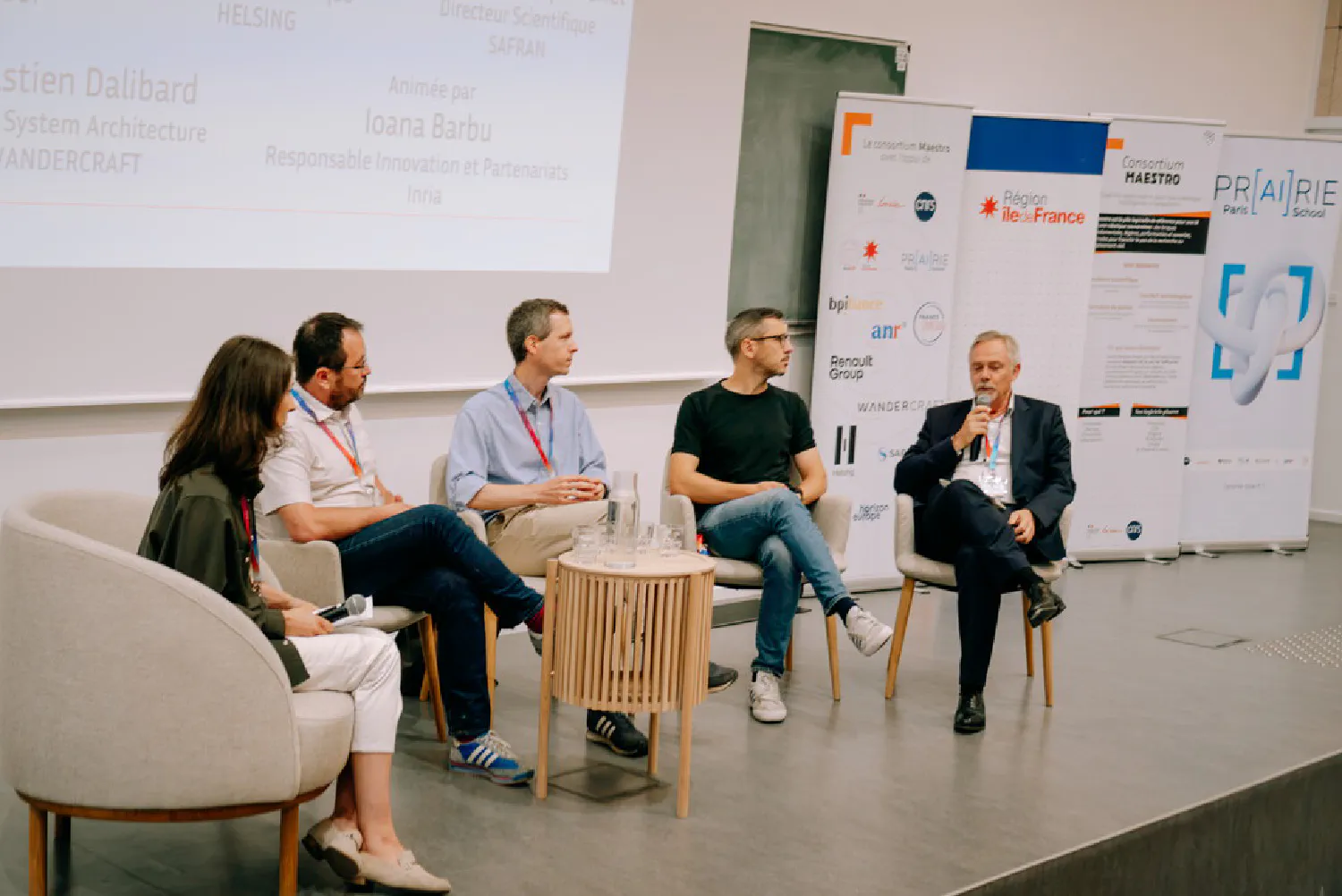
Industry at the Table: Physical AI and the Road to the Factory Floor
At the official Maestro launch event on 3 July 2026, representatives from Renault, Wandercraft, Helsing, and Safran joined a round table moderated by Ioana-Sorina Barbu on the challenges of physical AI and the role of open-source software in meeting them.
The discussion brought into focus the breadth of industrial contexts in which the Maestro stack is already relevant, from automotive assembly lines to medical exoskeletons, defence robotics, and aeronautical manufacturing. Across these sectors, the participants shared a common pressure: the pace at which robots need to be deployed and made to work reliably in real environments is increasing, and current methods are not keeping up. Getting robots onto factory floors and into the field faster is not an abstract ambition but an operational necessity.
Pinocchio featured throughout the conversation as a piece of infrastructure that participants are either already running in production or actively looking to adopt. For applications where safety is non-negotiable or compute is severely constrained, the performance and auditability of open-source software are hard requirements. Several participants also raised sovereignty as a genuine concern: the ability to inspect, trust, and build upon the tools at the core of one’s systems matters, particularly as robots take on more critical roles in industrial and defence contexts.
Underlying all of this was a shared belief that the challenges ahead cannot be met by research or industry working in isolation. The round table gave concrete expression to what the consortium is designed to enable: a sustained, productive exchange between the two, where industrial constraints sharpen research priorities and new capabilities reach deployment faster.